How to price a B2B SaaS product in Saudi Arabia
Most founders underprice out of fear of rejection. Price starts from the value you create for the customer, not from your cost or the competitor's price.
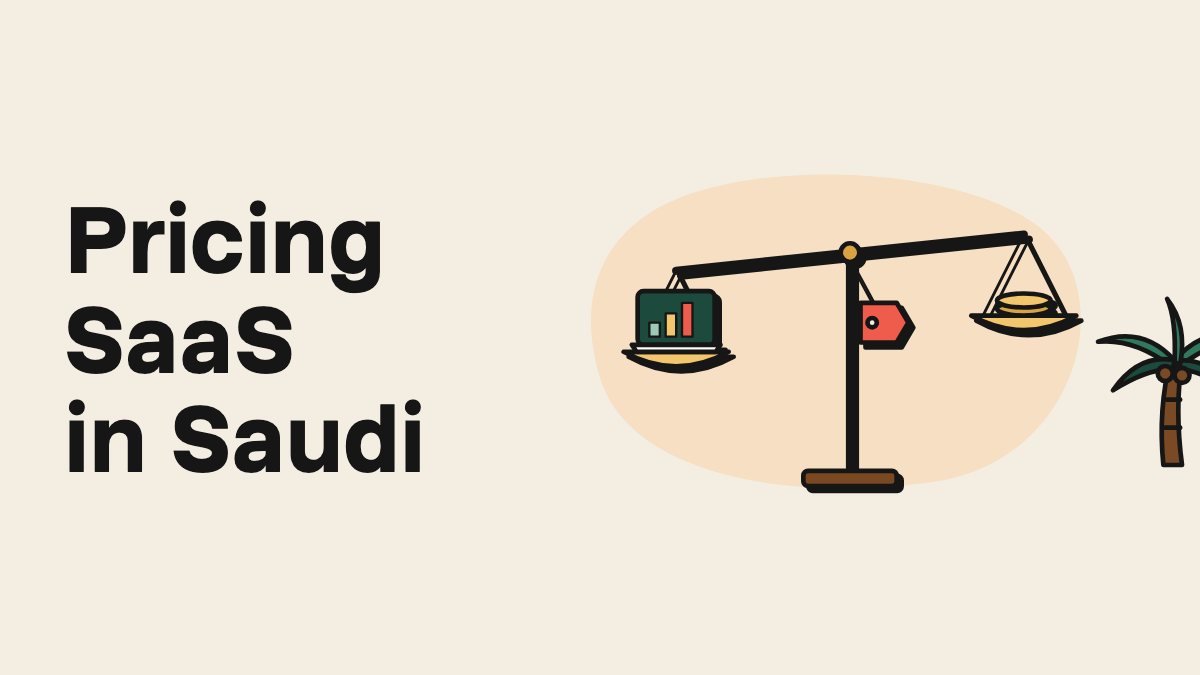
The most common pricing mistake we see: the founder sets a low price to "win customers first, then raise it later." The result is customers who came for the low price and leave as soon as they find something cheaper. And raising prices later is much harder than you expect.
Pricing isn't a number you pick once and forget. It's a product decision, and you test and adjust it like any feature.
Where does price start?
There are three reference points, and each gives you a boundary:
| Reference | What it sets | Common mistake |
|---|---|---|
| Your cost | The floor below which you lose money | Pricing at cost plus margin, and leaving money on the table |
| The alternative's price | The ceiling the customer compares against | Forgetting the alternative is often an employee or Excel, not a competing product |
| Value to the customer | The real ceiling | Never asking the customer how much they save or earn |
The right price usually sits between the alternative's price and the value you create. If your product saves the accountant two days a month, work out what those days cost the business, and take a share of it.
Common pricing models
Tiered subscription
The most familiar in SaaS. Tiers by customer size or features. Salla runs on subscriptions that start with a free plan, then paid plans based on the merchant's size. The free plan here is an acquisition tool, not charity: the merchant starts with no risk, and pays as they grow.
Subscription plus transaction fees
When your product touches the customer's money, you can take a small share of each transaction. Zid charges subscriptions and transaction fees. Foodics started with a subscription point-of-sale system, then added Foodics Pay with transaction fees, and Foodics Capital for restaurant financing. Revenue grows as the customer grows.
Per-unit pricing
Per employee, per branch, per device. It fits when value tracks volume. In an HR system like Jisr, value grows with headcount, so tying price to size makes sense for both sides.
What's specific to the Saudi market
- Compliance raises value: Rewaa combines point of sale, inventory, accounting and e-invoicing compliant with ZATCA. Qoyod was among the first approved e-invoicing providers. When your product solves a regulatory requirement, the customer doesn't compare you to a tool. They compare you to a fine.
- Annual vs monthly: small businesses prefer monthly, and large companies prefer one annual invoice that goes through procurement once. Offer both, and give annual a clear advantage.
- Riyals and VAT: show the price in riyals, and say clearly whether it includes VAT. Ambiguity here slows the decision.
- Integration with government systems: Jisr connects directly to systems like GOSI, Mudad, Qiwa and Muqeem. That kind of integration saves real time, and justifies a higher price than a global tool that doesn't know these systems.
How to test price
- Ask about budget early. In the first meetings, ask: "What do you spend today on solving this problem?" The answer gives you your reference.
- Say the number clearly. And watch the reaction. If nobody ever objects, your price is low.
- Raise for new customers only. Lock existing customers' price for a while, and test the new price on incoming ones.
- Don't confuse discount with price. A launch discount with an end date beats a permanently low price.
How many tiers do you need?
Three tiers are enough for most B2B products early on: an entry tier for small businesses, a middle tier you want most customers to choose, and an enterprise tier priced as "contact us." The enterprise tier opens the door to negotiating annual contracts with custom terms, instead of putting a ceiling on yourself from the start.
And don't lock too many features between tiers. A customer should understand the difference in seconds: size, number of users, or one clear feature.
Signs your price is too low
- Every customer agrees without discussion
- Deals close fast, but there's no difference between a serious customer and a hesitant one
- Your margin doesn't cover support and operations
- Customers use the product in a way that shows it's core to them, and pay less for it than a phone plan
If nobody tells you "that's expensive," you're probably cheap.
The idea is from YC: Most startups are undercharging and How To Price For B2B.