Your co-founder: how to choose them, and how to split equity
Most co-founder fights start with a decision made in week one, while everyone was excited. How to choose a partner, why an equal split is usually right, and what vesting is.
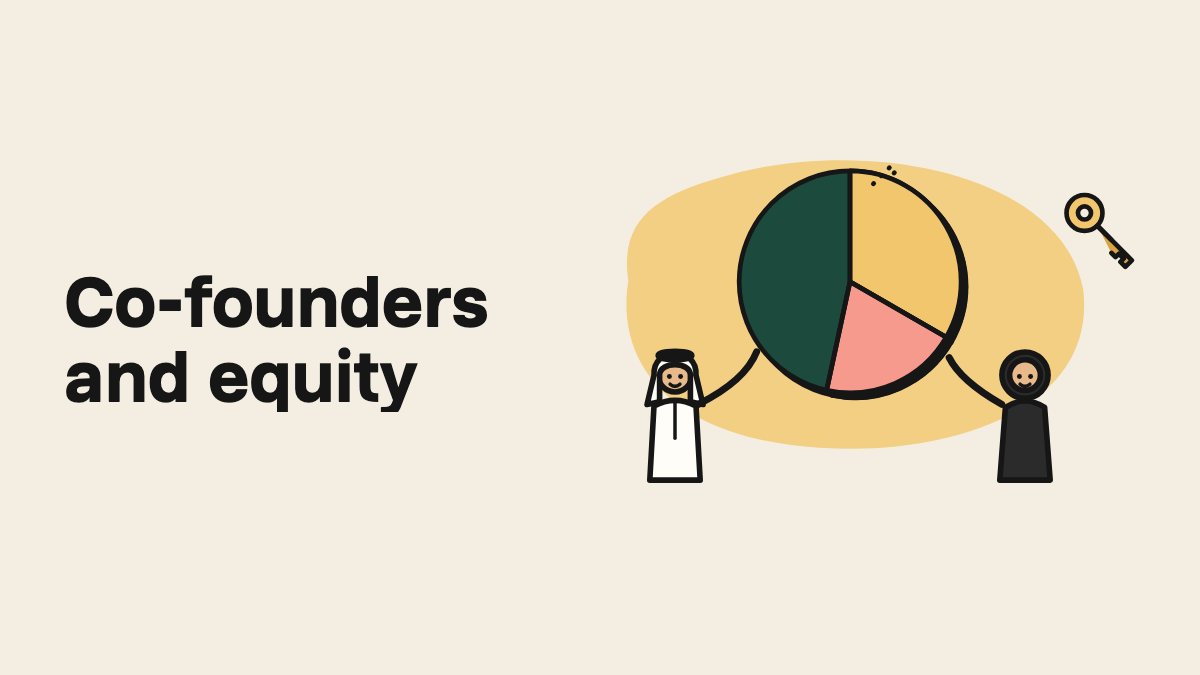
When you leave your job to start a company, the first big decision often isn't the product. It's who'll be with you. And the second decision comes right after: how you'll split the company. The problem is that both get made when you're most excited and least willing to "ruin the mood" with a hard conversation.
Why have a co-founder at all?
There's no rule that a company must have a co-founder, and there are successful companies with a single founder. But the work in the early years is heavier than one person, and hard decisions are easier when someone challenges you honestly.
Examples from our directory of different setups:
- Classmates and colleagues: Ahmad AlZaini and Mosab AlOthmani founded a software company in 2010 after studying at King Fahd University of Petroleum and Minerals, and Foodics later came out of it.
- Brothers: at Nice One, Abdulrahman Al Olayan imported a beauty product and his brother Omar Al Olayan sold it on Instagram.
- A side project: Naif Alsamri and Ayman Alsanad built Mrsool in their spare time.
- A co-founder who joins later: Ahmed Al Rawi started Calo, and Moayed Almoayed joined as co-founder.
- A large team: Rasan was founded by seven founders.
How to choose a co-founder
| Ask | Why |
|---|---|
| Have we worked together under pressure? | Friendship in good times isn't enough. See how they act when things break |
| Do our skills complement each other? | Two founders who build and nobody who sells is a problem |
| Do we want the same thing? | One wants a big funded company, the other a calm profitable business: a deferred fight |
| Are we equally committed? | A gap in commitment is the biggest source of resentment later |
| How do we decide when we disagree? | Agree now who has the final say in each area |
The best way to know a co-founder: work on something small together before you register a company. A two-week project reveals more than a year of conversations.
The split: why equal is usually right
The founder who brought the idea feels they deserve more. But on day one the idea is worth very little compared with the work ahead: years of building, selling, hiring and fundraising. If both are full-time and in it for the long run, an equal or near-equal split protects what matters most: each person feeling like a real owner.
When does an unequal split make sense?
- One is full-time and the other isn't
- One put in a large sum of their own money (often better recorded as a loan or investment than as founder equity)
- One joined after there was already a product and customers
What matters is that the reason is clear and written down, not a feeling.
Vesting: the protection everyone forgets
Vesting means your shares aren't fully yours from day one; you earn them over time. The common structure globally:
- Four years to vest fully
- A one-year cliff: leave before the first year and you get nothing
- After the first year, shares vest monthly or quarterly
Why it matters: imagine a co-founder takes 50% and leaves after six months. Without vesting, they still own half the company while you work alone. And the first investor will ask about it.
How vesting applies legally depends on your company's structure and where it's registered. Put it in the shareholders' agreement, and have a lawyer draft it.
Control after investment
The first split isn't the end of the story. Your stake drops with every round, and with a sale, decisions can leave your hands. At HungerStation, Foodpanda acquired the largest stake in 2016, and Delivery Hero later ended the contracts of the two founders and senior management in 2019. Know from the start which rights you want to keep, and which you're willing to give up.
The shareholders' agreement: what it must cover
- Equity percentages and the vesting schedule
- Roles, and who decides in each area
- What happens if someone leaves, dies, or doesn't commit
- Ownership of code and brand by the company, not by individuals
- How disputes are resolved
A hard conversation today is far cheaper than a fight after the company succeeds.
The idea is from YC: How to split equity among co-founders.