How do you know you've reached product-market fit?
You don't have to ask whether you have product-market fit. You feel it when demand pulls you instead of you pushing it. Here are the signs, and what to do before you get there.
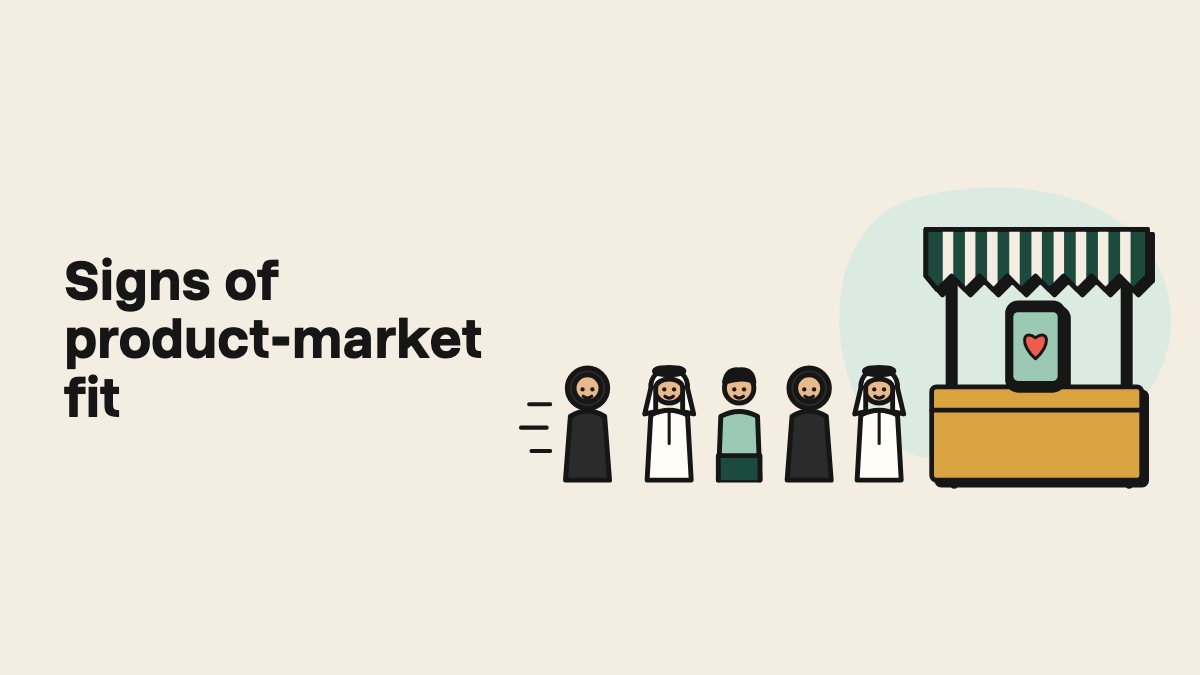
Product-market fit is the moment the market starts pulling your product out of your hands, instead of you pushing it onto the market. Before it, everything is heavy: every customer takes effort to win, and every customer leaves easily. After it, the problem changes from "how do I convince people?" to "how do I keep up with demand?"
Most founders ask "are we there yet?" The honest answer: if you have to ask, you probably aren't.
Signs you're there
| Sign | What you see on the ground |
|---|---|
| Demand outruns capacity | The team can't keep up, and operations get tired before marketing does |
| Usage comes back on its own | The same customers return every week without a reminder |
| Referrals without incentives | New customers say "so-and-so told me about you" |
| People get upset when it stops | If it's down for a day, your phone doesn't stop ringing |
| Sales get shorter | The first meeting is about details, not about the idea |
Examples from the Saudi market
Nana: during the 2020 lockdown it tripled its operating capacity in 10 days. That is what pulling demand looks like: the problem became "how do we keep up?" not "how do we convince?" The company later went through hard times and entered financial reorganization in 2026, a reminder that fit at one moment doesn't guarantee economics that work over the long run.
Sary: sales in March 2020 came to roughly half of all 2019 sales. When one month is close to half a year, the market is telling you something.
Noon: it started in late 2013 as paid tutoring by subscription, and students didn't subscribe. It switched to a free model with paid services, and reached 100,000 students in the fall 2014 term after the switch. The lesson: sometimes the missing fit is in the model, not the idea.
Foodics: its first product was a digital menu on the iPad, then in 2014 it became a cloud point-of-sale system. Same customer (the restaurant), but a deeper and more painful problem.
Before you get there: what to do
1. Narrow the market until it hurts
Don't build for "restaurants" or "small businesses." Build for one type, in one city, with one problem. A narrow market lets you hear a clear signal instead of noise.
2. Measure return, not signups
Signups lie. What matters: how many came back after a week? After a month? If your return curve slides to zero, you don't have fit no matter how big the signup number is. More in our piece on retention.
3. Talk to customers every week
No analytics tool replaces a call with a real customer. Ask: if our product disappeared tomorrow, what would you do? If the answer is "fine, I'd go back to Excel," you have work to do.
4. Take money early
A paying customer gives you more honest information than a thousand "nice idea"s. The first riyal from a customer is a fit test in itself.
5. Don't grow the team or spend on marketing
Before fit, every riyal on ads buys customers who will leave. Every extra hire slows your ability to change. Protect your cash until you know what works.
False signals
- Launch buzz: lots of signups in week one, then silence.
- Customers from your network: they're being polite, and they don't represent the market.
- A free pilot with a big organization: great, but it isn't fit until it becomes a paid contract that renews.
- Discount-driven growth: if demand stops when the discount stops, you were buying demand, not earning it.
Questions founders ask
Is fit something you reach once and keep?
No. Markets change, competitors arrive, and your customers grow and their needs shift. The fit you have today with one segment can weaken in two years. Keep watching your return and referral numbers, not just at the start.
I have fit with a small segment. Is that enough?
That's the best possible start. A small segment that loves you beats a big market that doesn't care. Expand from it to a nearby segment with the same problem, step by step.
When to move to the next stage
When you see three of the signs above together for several months, not one week. That's when you start investing in hiring and channels, and prepare for your funding round.
Fit isn't announced in a meeting. You know it from the pressure demand puts on your team.
The idea is from YC: The Real Product Market Fit.