Growth loops vs funnels: how companies actually grow
A funnel explains how a visitor becomes a customer. A loop explains how that customer brings in the next one. The difference decides whether your growth compounds or you pay for it again every month.
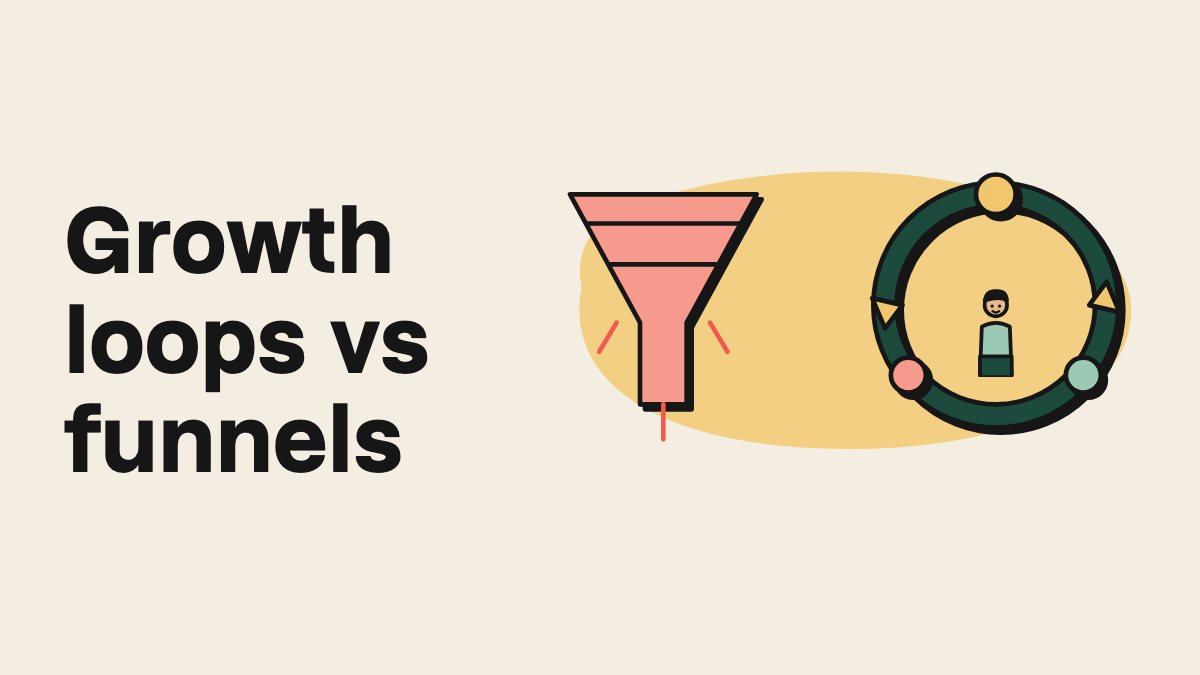
Most growth plans we see from founders are shaped like a funnel: ad, visit, signup, activation, payment. And every month you start at the top again: you spend on ads to refill the funnel. It works, but it doesn't compound. What makes growth accelerate is a loop.
The difference, simply
| Funnel | Loop | |
|---|---|---|
| Starts with | An outside input (ads, sales) | An output of the product itself |
| Ends with | A paying customer | A paying customer who generates a new input |
| Cost over time | Flat or rising | Falling per new customer |
| Key question | Where are the leaks between stages? | What comes back into the loop from each customer? |
The funnel doesn't go away. It's part of every loop. But a loop asks one more question: once I have a customer, what comes out of them that brings in the next customer?
Types of loops, with local examples
The two-sided marketplace loop
Each side attracts the other. In Mrsool, the customer writes their order freely, and nearby couriers make price offers. The more customers, the more reason for couriers to work; the more couriers, the faster and cheaper the offers for the customer.
The same logic applies to buy-now-pay-later: Tabby has 25 million users and 70,000 merchants (September 2026). Merchants join because shoppers want the option, and shoppers use it more because it's available at more merchants.
In Lendo the two sides are completely different: businesses that need financing, and individual investors who fund them starting from SAR 1,000. Each new business gives investors more opportunities, and each new investor gives businesses faster funding.
The data loop
The first product generates data, and the data powers a second product. Foodics started with a point-of-sale system, which gave it restaurant sales data. On that data it built Foodics Capital: restaurant financing based on sales, repaid through a small deduction from daily card settlements. A restaurant using the POS now has one more reason to stay.
Lean is an example of a data loop between businesses: Tamara reported a 32% rise in approval rates after using Lean's data (March 2026). A result like that becomes the sales story for the next customer.
The content loop
Users create content, the content brings visitors from search or social, and visitors become users. It works when the content has value for people other than its creator.
The invite loop
The user needs someone else to get value: sending an invoice, splitting a bill, inviting their team. Every use exposes the product to a new person.
How to map your loop
- Write the steps on paper: where does the new customer come from? What do they do? What comes out of them?
- Look for the output: does the customer's usage produce something that reaches new people (an invite, content, data, an offer to the other side)?
- Measure one turn of the loop: how many new customers come from every 100 existing ones? And how long does it take?
- Work on the weakest point: a loop with a broken step doesn't turn, however much you spend on the others.
How to tell the loop is working
Watch two numbers: the share of new customers who came from inside the loop (an invite, the other side, content) compared with those from ads, and your acquisition cost over time. If the loop works, the first number rises and the cost falls, even if your marketing budget doesn't change. If both stay flat, you have a funnel dressed up as a loop.
Common mistakes
- Calling anything a "loop": a referral program with a small discount isn't a loop if customers don't use it.
- Many loops from the start: get one working before you build the next.
- Neglecting the funnel: a loop needs every step to be sound. Weak activation breaks any loop.
- Forgetting quality: in a two-sided market, if one side grows and the other can't keep up, the experience breaks and the loop turns in reverse.
When the funnel is enough
Early on, before product-market fit, the funnel is enough. You need to understand who buys and why. You build the loop once you have a product people love, because a loop amplifies what's there, and a weak product gets its weakness amplified.
You refill a funnel every month. A loop refills itself.
The idea is from Lenny's Newsletter: Demand driving supply.